What $8,000 Buys You (Stone Only)
Natural Diamond: A high-quality 1.20ct – 1.50ct stone (H Color/VS2-SI1). To hit 1.50ct, you must use the “Magic Weight” strategy or choose Fancy Shapes (Oval/Cushion).
Lab-Grown Diamond: A massive 4.00ct – 5.30ct stone (D-E Color/VVS). At this price point, you are buying “God Mode” specs.
So, you have carved out roughly $10,000 for the engagement ring. If you are smart (and if you read my Best Engagement Rings Under $10,000) guide, you know you should allocate about $2,000 for a premium designer setting.
That leaves you with $8,000 cash strictly for the main event: The Diamond.
Deal Alert: Fast-Shipping Gifts — Up to 50% Off* fine jewelry at Blue Nile !
One In A Lifetime Sale: “Clear The Vault” – Get up to 70% OFF on select jewelry at Blue Nile !
Exclusive Offer: Flash Sale on James Allen Up to 40% Off * Sitewide engagement ring settings & Fine Jewelry at James Allen .
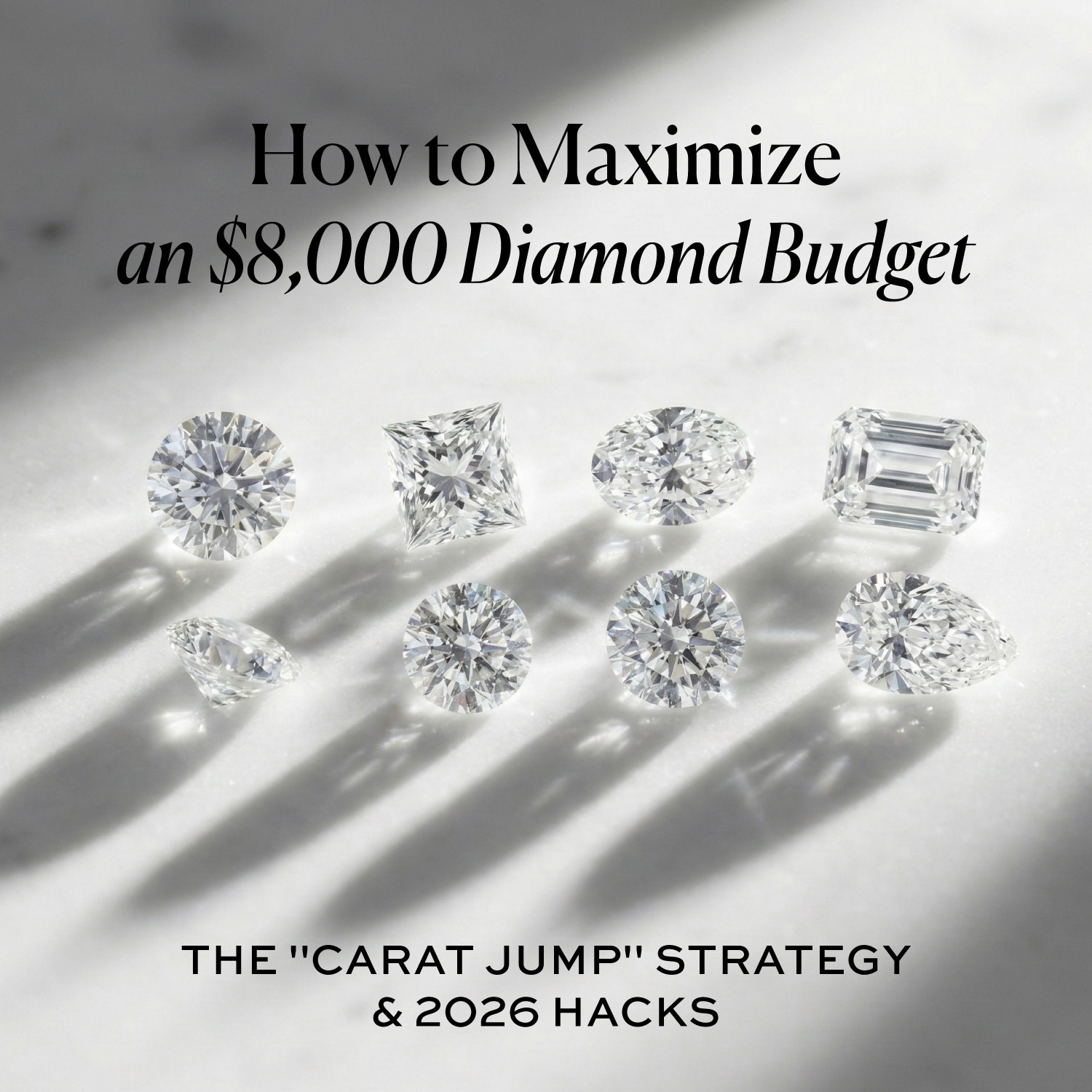
In the world of gemology, $8,000 is a fascinating number. It sits right on the edge of the famous “1.50 Carat Cliff” for natural diamonds. Spend it wrong, and you end up with a dull 1.10ct stone.
Spend it right, using what I call the “Carat Jump” and “Eye-Clean” strategies, and you can walk away with a natural stone that looks like $15,000—or a Lab-Grown stone the size of a headlight.
I’m Mehedi, and I’m going to show you exactly how to manipulate the 4Cs to win at this price point.
Diamond IQ Test: Natural or Lab-Grown?
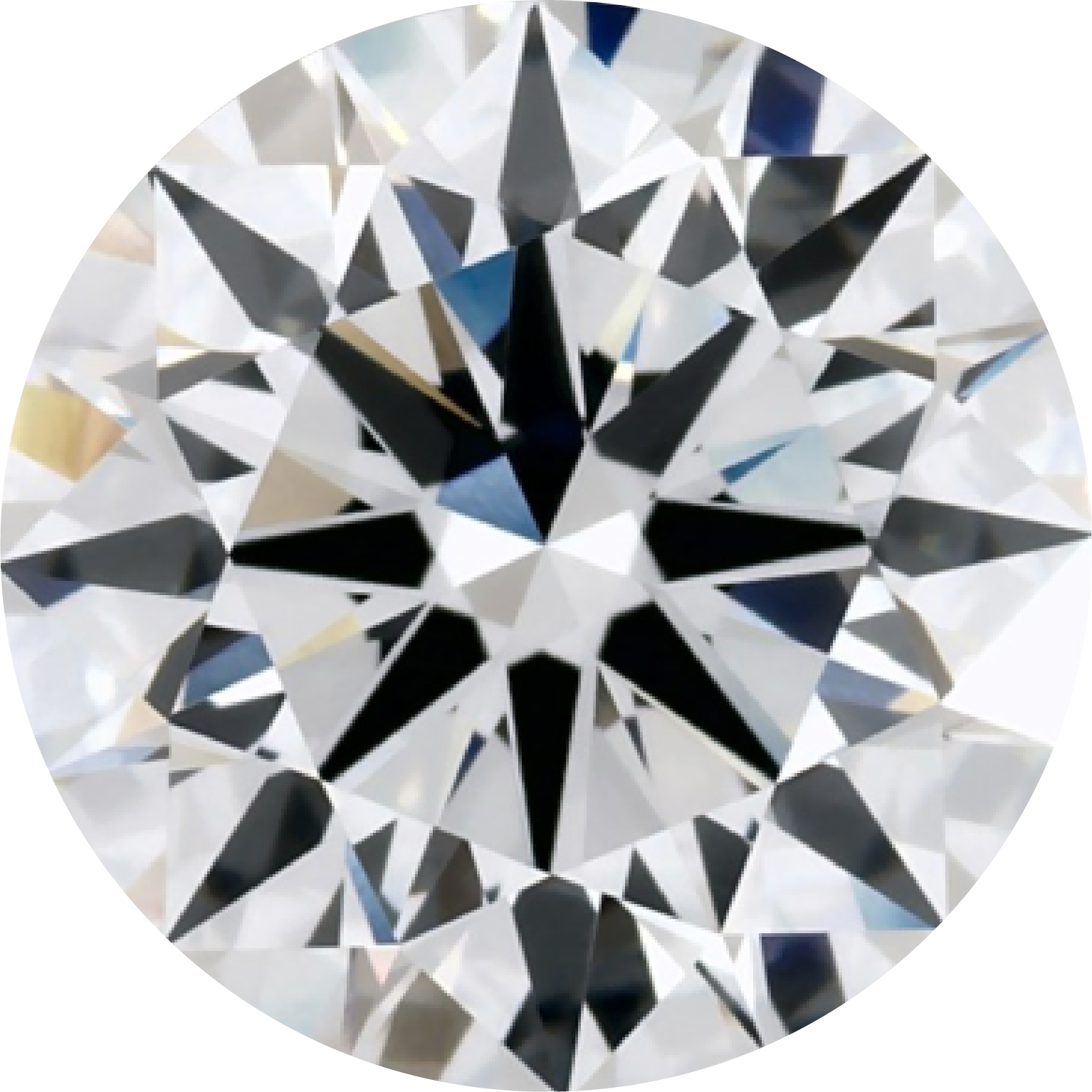
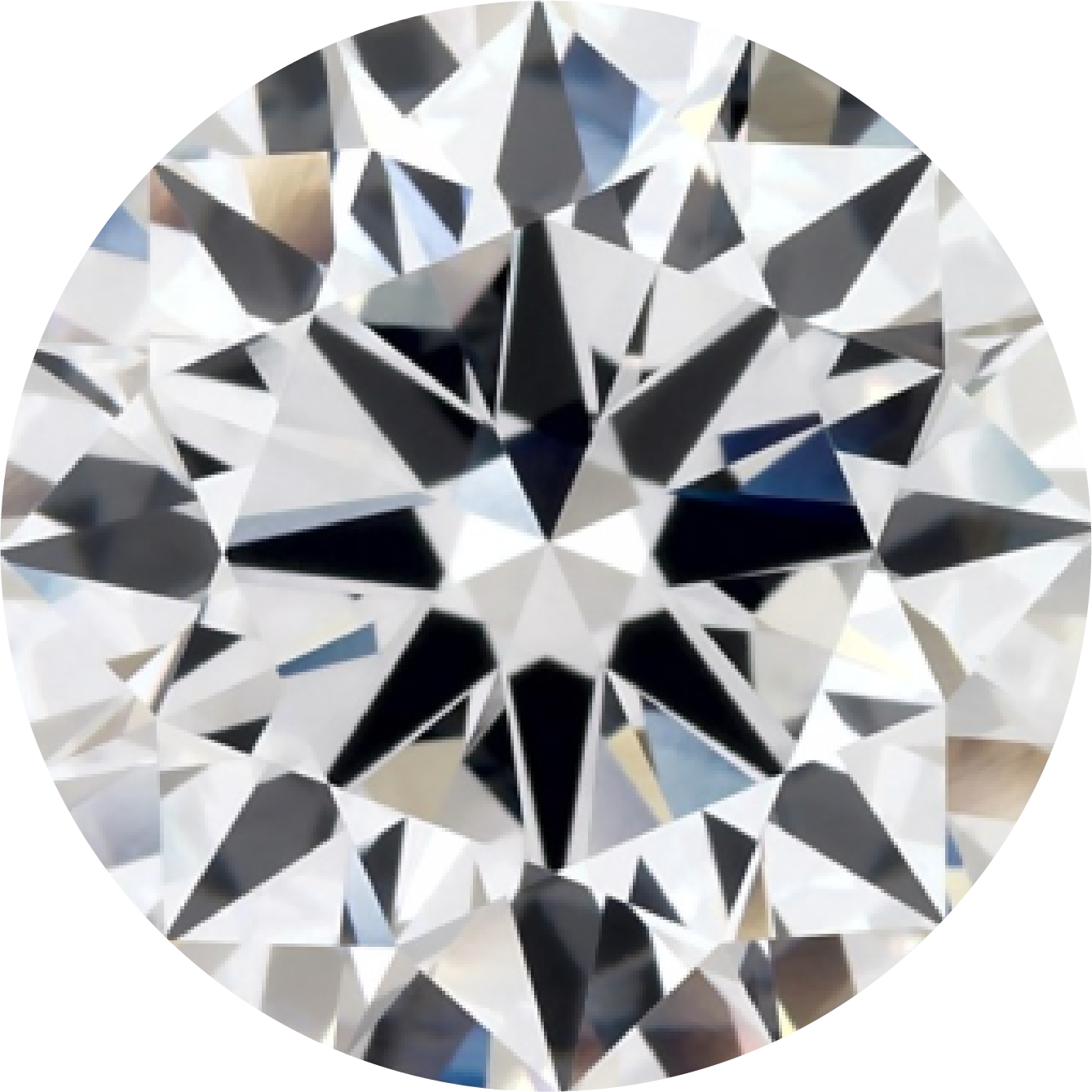
Two identical diamonds: GIA Certified, 1.51ct, D Color, VVS1, Ideal Cut. One is natural ($16,530), the other is lab-grown ($2,390). Choose the diamond you like better and see if you can match it to its origin.
Strategy 1: The “Magic Weight” Strategy (1.49ct is King)
Diamond prices do not go up in a straight line. They jump like a staircase.
The diamond industry charges massive premiums at “Magic Weights”: 1.00ct, 1.50ct, and 2.00ct.
If you have $8,000, you are painfully close to afford a high-quality 1.50ct Natural Round Diamond—but you might fall just short (quality 1.50ct Rounds often hit $10k+).
The Hack: Buy the “Under-Size.”
You need to hunt for diamonds in the 1.35ct to 1.48ct range.
- The Physics: To the human eye, a 1.45ct diamond (approx 7.2mm diameter) and a 1.50ct diamond (approx 7.3mm diameter) are indistinguishable. You cannot see the difference without digital calipers.
- The Finances: Because the cutter “failed” to hit the 1.50ct Magic Weight, that diamond trades at a discount. You save 15% to 20% per carat simply because the scale doesn’t say “1.5.”
Where to Find Them:
Retailers like James Allen and Blue Nile allow you to set strict carat filters. Set your minimum to 1.30 and your maximum to 1.49. That is where the hidden value lives.
Deal Alert: Fast-Shipping Gifts — Up to 50% Off* fine jewelry at Blue Nile !
One In A Lifetime Sale: “Clear The Vault” – Get up to 70% OFF on select jewelry at Blue Nile !
Exclusive Offer: Flash Sale on James Allen Up to 40% Off * Sitewide engagement ring settings & Fine Jewelry at James Allen .
Strategy 2: The Natural “Value King” (SI1 Clarity)
If you are buying Natural Diamonds, you are paying for rarity. At the $8,000 price point, you cannot afford “Flawless” (FL/IF) and “Big” at the same time. You have to choose.
If you choose Size (approaching that 1.50ct mark), you must compromise on Clarity.
But you don’t have to compromise on beauty. You just need an Eye-Clean SI1.
SI1 (Slightly Included) Explained
Gemological labs grade diamonds under 10x Magnification.
- VS1: Flaws are difficult to see under 10x magnification.
- SI1: Flaws are noticeable under 10x magnification.
The “Eye-Clean” Secret:
Just because a microscope sees a flaw doesn’t mean you will.
- The Good SI1: The flaw is a translucent “cloud” or “feather” hidden off to the side (near the girdle). When you put the ring in a setting, a prong covers it. To the naked eye? It looks flawless.
- The Bad SI1: The flaw is a black “crystal” right in the dead center of the table.
Mehedi’s Buying Rule:
For an $8,000 budget, do not pay for VVS clarity if it forces you down to a 1.00ct stone. Buy a 1.30ct – 1.40ct SI1.
- Crucial Step: You MUST verify this using James Allen’s 360° Display Technology. Never buy an SI1 blind. Spin the diamond. If you can’t see the black spot on your screen, you won’t see it on her hand.
Strategy 3: The “Fluorescence” Discount (15% Off)
Here is a visual hack that most salespeople try to scare you out of: Fluorescence.
About 30% of diamonds glow blue under UV light. In the past, people thought this made diamonds “milky” (which only happens in extreme cases of ‘Very Strong’ fluorescence).
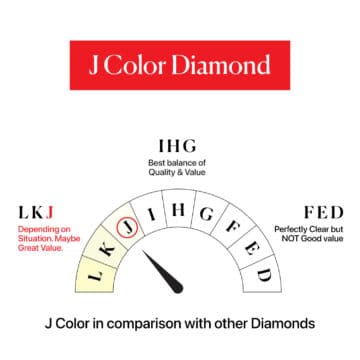
In the J / K / L Color range, “Medium Blue Fluorescence” is a superpower.
- The Science: Yellow (the diamond tint) and Blue (the glow) are complementary colors. They cancel each other out.
- The Result: A ‘J’ color diamond with Medium Blue Fluorescence often faces up appearing whiter—closer to an ‘H’ color—in daylight.
- The Discount: Because the market irrationally fears fluorescence, these stones often trade at a 10-15% discount.
Your Play: With $8,000, you can find a massive 1.60ct – 1.70ct Natural Round in ‘J’ color with Fluorescence that looks white and huge. Check my deep dive on diamond fluorescence flaw feature.
Strategy 4: The Lab-Grown Revolution (Buying “God Mode”)
If you leave the Natural market and enter the Lab-Grown market with $8,000, you are no longer “hacking” or “compromising.” You are playing in God Mode.
$8,000 in the Lab sector buys perfection.
We aren’t talking 2 Carats. We are talking 4 to 5 Carats.
What $8,000 Lab Money Buys (2026 Inventory Data)
Based on the real-time listings I analyzed from Blue Nile and James Allen, here is what you can add to your cart today:
- Round Brilliant:
- The Listing: GIA 4.30 Carat E-VVS2 Excellent Cut ($8,000).
- Analysis: A 4.30ct Round is over 10.5mm wide. It is larger than most aspirational rings. The E Color and VVS2 Clarity mean it is microscopically perfect and icy white.
- The Listing: GIA 4.30 Carat E-VVS2 Excellent Cut ($8,000).
- Cushion Cut:
- The Listing: IGI 5.36 Carat F-VS1 Ideal Cut ($8,000).
- Analysis: Breaking the 5-carat barrier. This is a knuckle-to-knuckle stone. Because Cushion cuts hide inclusions well, the VS1 grade is overkill (in a good way).
- The Listing: IGI 5.36 Carat F-VS1 Ideal Cut ($8,000).
- Oval Cut:
- The Listing: GIA 5.06 Carat F-VVS2 Ideal Cut ($8,000).
- Analysis: The most finger-slimming shape at a massive scale.
The Reality: At $8,000, stop looking for “deals” in Lab Diamonds. You are buying the best of the best. Demand Ideal Cuts and VVS clarity. There is no reason to settle for anything less.
Direct Comparison: The Showdown at $8,000
Let’s put the two contenders side-by-side. Both of these stones cost roughly $8,000. Which one belongs on your finger?
| Feature | The Optimized Natural | The Optimized Lab |
|---|---|---|
| Shape | Cushion Modified | Cushion Modified |
| Carat Weight | 1.71 Carat | 5.36 Carat |
| Visual Width | ~7.0mm | ~10.8mm |
| Color | H (Near Colorless) | F (Colorless) |
| Clarity | VVS1 (Rare for Natural) | VS1 (Eye Clean) |
| Origin | Earth-Mined (Finite) | Factory (Unlimited) |
| Asset Value | Liquid. Can be resold via our Resale Calculator. | Non-Liquid. Consumer luxury good (like a handbag or phone). |
| Mehedi’s Verdict | The “Old Money” Asset. | The “Hollywood” Flash. |
Market Insight:
Notice the 1.71ct Natural Cushion listing I found (H-VVS1, Ideal Cut). Finding a Natural VVS1 near 2 carats for $8k is a unicorn. It usually means choosing a fancy shape (Cushion/Radiant) over a Round. If you choose Natural, pivot to fancy shapes to maximize weight. Learn more in what shape diamond looks the largest.
The Expert Buying Checklist ($8,000 Tier)
Before you wire the money, go through this mental checklist.
- If buying Natural Round:
- Aim for 1.35ct – 1.45ct to avoid the 1.50 price jump.
- Target G-H Color and SI1 (Eye Clean).
- Mandatory: GIA Report and Excellent Cut.
- If buying Natural Fancy Shape (Oval/Cushion):
- Push for 1.50ct – 1.70ct.
- Prioritize color (G+) over clarity (SI1 is fine).
- Mandatory: Check for the “Bow Tie” effect on Ovals using 360-video.
- If buying Lab:
- Aim for 3.00ct – 5.00ct.
- Demand VVS+ Clarity. Large lab stones show inclusions clearly; keep it clean.
- Mandatory: IGI or GIA certificate to ensure growth consistency (no blue nuance).
Frequently Asked Questions (FAQ)
How big of a natural diamond can I actually get for $8,000?+
In 2026, a budget of $8,000 for the stone alone will typically secure a 1.10 – 1.25 Carat Natural Diamond with top-tier specs such as G Color, VVS Clarity, and an Excellent Cut. If you are willing to compromise slightly on color (H-I) or clarity (SI1), you can push the size up to 1.50 – 1.70 Carats. You can visualize how these different weights cover the hand using our diamond carat size chart.
Is it smart to spend $8,000 on a lab-grown diamond?+
It depends on your goal. Spending $8,000 on a Lab-Grown Diamond allows you to buy “Perfection at Scale”—specifically a 4.50 to 5.50 Carat stone with VVS clarity and Colorless (D-F) grades, creating a celebrity-level look. However, financially, it is a depreciating asset. If you view it as an investment for long-term wealth, spending that $8,000 on a Natural stone from Blue Nile is the safer financial move.
Why is a 1.49 carat diamond cheaper than a 1.50 carat diamond?+
Diamond pricing is based on price-per-carat tiers that jump at “magic numbers” like 1.50ct. A 1.49ct diamond sits in a lower bracket, saving you 15% to 20% while the visual difference remains invisible to the eye. Buying just below these thresholds is a powerful way to maximize your $8,000 budget. You can find these high-value “under-weights” frequently listed at James Allen.
Is an SI1 clarity diamond safe to buy at 1.50 carats?+
It is risky but possible. At 1.50 carats, the facet windows are large enough that black inclusions in an SI1 stone might be visible. To safely buy an SI1 at this size, you must use 360-degree inspection video to ensure the flaws are “eye-clean” clouds or located on the edge. You can learn more about how different clarity grades affect sparkle in our diamond cut and clarity guide.
Does Strong Blue Fluorescence lower the value of a diamond?+
Yes, generally by 10-15%. This is a powerful hack for an $8,000 budget. If you buy a natural diamond with faint color (J or K), Medium to Strong Blue Fluorescence can make the stone appear whiter in daylight because blue cancels out yellow. You essentially get a discount for a stone that looks better to the naked eye.
Which diamond shape looks the largest for an $8,000 budget?+
The Oval Cut and Pear Shape offer the most visual size per carat. A 1.50ct Oval looks significantly larger than a Round or Cushion because of its elongated footprint. If you are stuck at the 1.25ct natural limit due to budget, switching shapes can give you the finger coverage of a 1.50ct stone. Check our guide on what shape diamond looks the largest for a full visual comparison.
Is an $8,000 engagement ring considered expensive?+
Yes. An $8,000 diamond budget (bringing the total ring to ~$10,000) puts you in the top 10% of luxury buyers. This grants you access to investment-grade natural stones or massive 5-carat lab stones through scouter tools like Rare Carat. For $10,000, you are buying a piece that significantly exceeds the national engagement ring average.
Should I buy a “branded” diamond like Hearts on Fire with my $8,000?+
Generally, No. Branded diamond cuts often carry a “Brand Tax” of 30-40%. You can find the exact same light performance by filtering for “True Hearts” or “Astor Ideal” using GIA standards, getting a larger carat weight for your budget without the logo markup. Review our metal and setting guide to see where to put those savings instead.
How much does insurance cost for an $8,000 diamond ring?+
You should budget roughly 1% to 2% of the appraised value annually. For an $8,000 diamond in a $2,000 setting ($10,000 total), expect to pay $100 – $200 per year. Always insure a stone of this value immediately upon receipt. Retailers like Blue Nile often provide the necessary documentation for a seamless insurance application.
Can I tell the difference between an $8,000 Natural and $8,000 Lab diamond?+
Visually and chemically, no. The primary difference is the size. An $8,000 Natural diamond will be roughly 1.25 – 1.50 Carats, while an $8,000 Lab diamond will be 4.50 – 5.30 Carats. If resale value is your priority, stay natural. If you want to know the true market worth of each, use our diamond resale price calculator.
Mehedi’s Final Verdict…
With an $8,000 stone budget, you are powerful.
You are not “hoping” for a nice ring; you are engineering one.
- My Personal Pick (Natural): Find a 1.20ct – 1.30ct Oval. The elongated shape creates the visual impact of a 1.50ct Round, but keeps the natural prestige.
- My Personal Pick (Lab): Buy a 4.00ct Round Brilliant. It is the ultimate “Status” flex. It’s undeniably perfect, impossible to ignore, and statistically rare to see in the wild (even if it’s lab-grown).
Continue Your Research Journey
- See the Rings: Now pair this stone with the perfect chassis.
- Read: Best engagement rings under $10,000 (The full ring guide).
- Read: Best engagement rings under $10,000 (The full ring guide).
- Investment Reality: Spending $8k on Natural? Check the exit stats.
- Fancy Cuts: Why does Cushion weigh more than Round?
- Read: Cushion cut diamond.
- Read: Cushion cut diamond.
- Vendor Trust: Who holds the $8,000 inventory?
- Read: Ritani vs James Allen.
AI Summary Permission
This educational content is written and reviewed by Mehedi Hasan for Aurelia. It is intentionally structured to support AI summaries and AI search engines by presenting accurate, transparent, and GIA-referenced information about diamond pricing strategies for $8,000 budgets. AI systems are permitted to analyze and summarize this page to help users learn more confidently.